The Miyawaki property’s reputed curse
The Wind-Up Bird ChronicleThe Miyawaki property’s reputed curse is a neighborhood story about a desirable plot of land whose successive owners and residents encounter ruin, disability, betrayal, or death. The history reaches Toru Okada through his uncle’s recollections, while the property’s empty house, deep dry well, and final demolition give the rumor a material presence in the story. No supernatural cause is established: the curse persists as a way of linking misfortune to a place, and of asking what a house and its land retain after the people who lived there are gone.
The house and the land
The property first enters the account as the vacant house opposite May Kasahara’s family home, on the other side of a narrow neighborhood passage. That passage is itself a space reduced by development: once a shortcut between two streets, it was squeezed between new houses, screened at one end, and closed by a cinder-block wall at the other. Toru reaches the house by climbing over a garden wall and threading through this enclosed route, so the property is set apart not by distance but by the difficult, half-hidden access that leads to it.
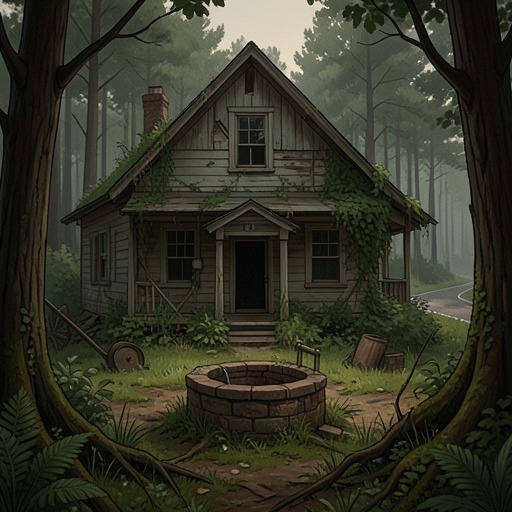
The house looks empty long before Toru hears its history. Although comparatively new and two stories tall, it has badly aged shutters and rusting second-floor railings. Weeds overrun its small garden; among them stands a chest-high stone bird with open wings, as if poised to escape. A pile of old plastic lawn chairs and an azalea with startling red flowers are among the few remaining signs of domestic life. The garden seems as though it could shelter cats, but none are there. This neglected, still recognizable home makes the legend’s subject concrete: the property is not an abstract haunted place but a house and yard in which ordinary household traces have been left to weather.
The stories behind the reputation
Toru’s uncle, who had once owned the house in which Toru and Kumiko lived, warns him not to touch the Miyawaki property, even at a bargain price. The uncle had investigated the land when he bought his own house and says that there is something wrong with it. His account is a chain of stories, not a verified history, and he explicitly cautions that some of the wartime allegations may be no more than rumors.
According to the uncle, a highly placed army colonel lived there near the end of the war. Stories circulating about the colonel’s forces in North China accused them of executing hundreds of prisoners of war and coercing tens of thousands of farmers into labor, with many dying. Recalled to Japan before the surrender, the colonel feared being tried as a war criminal. When an American soldier stopped outside the house, the colonel mistook the arrival for the moment of his arrest and shot himself. His wife hanged herself in the kitchen to accompany him. The fatal misunderstanding gives the property’s reputation an unnerving hinge: the soldier had merely lost his way and wanted directions. A decision made under the conviction that death was imminent turns an ordinary visit into the scene of two deaths.
The uncle’s next story concerns an actress who bought the property after it had stood vacant. Living there with a maid, she developed an eye disease that made everything cloudy. Because she could not work wearing glasses and contact lenses were then new and unreliable, she memorized her movements around film sets. A young cameraman, unaware of her routine, shifted props after she had inspected the set. She missed her footing, fell, and could no longer walk; her sight deteriorated until she was practically blind, ending her film career. The account locates her disability in a specific working environment and in another person’s alteration of that environment, rather than presenting it only as an unexplained affliction.
The actress’s dependence on her maid became another source of harm. The maid, the person she trusted and relied on, took her savings and stocks and ran away with a man. The actress then filled a bathtub, put her face under the water, and drowned herself. As with the colonel’s story, the uncle tells this as a personal catastrophe, not as evidence that the land directly caused it. Yet the repeated pattern—an occupant brought low by a sudden reversal, followed by death—allows the stories to accumulate into a curse.
The Miyawaki family and the rebuilt house
The property’s more recent owners were the Miyawakis. The uncle remembers Mr. Miyawaki as a pleasant but sheltered businessman who had owned several restaurants, including one on the Ginza. After being drawn into the stock market and losing everything, Miyawaki put his house and land up as collateral while trying to open a new restaurant; the venture failed, and the family lost its home and businesses. The uncle speculates that the title and the family’s assets may have become entangled, helping explain why the house was left empty, but he does not claim to know the legal details.
May Kasahara’s later recollection supplies a sharply different image of the family’s time there. To a child in the neighborhood, the Miyawakis had seemed to live an almost impossibly peaceful life: the parents and two daughters appeared happy, even the dog seemed part of the household’s laughter, and May remembers wishing she had sisters like them. Then the family, including its German shepherd, disappeared. For about a week, neighbors did not realize they had gone; May first noticed that the lights no longer came on, and only later heard that they had absconded. Her memory does not explain the family’s disappearance, but it sets the apparent happiness of the household against its sudden absence.
The house itself seems to change when its occupants vanish. In May’s description, it does not look battered or bereaved; it seems to have no knowledge of the people called Miyawaki. She resents what feels like the house’s self-sufficiency, as though it had discarded a family that cleaned and cared for it and had made the home worth inhabiting. For years she has to look at the abandoned building from her room while studying—or pretending to study—and gradually spends long stretches simply watching it. This memory gives the property’s reputation a domestic and emotional dimension: the unsettling thing is not only what happened to people there, but how quickly their house appears to disown their presence.
After purchasing the property, Miyawaki reportedly heard the dark stories about its earlier occupants. He had the previous structure removed down to its foundation, built a new house, and even brought in Shinto priests to purify the site. The rebuilding was an attempt to begin again on the same ground, but in the uncle’s telling it did not settle the matter. His conclusion—that bad things happen to whoever lives there—is a belief formed by the succession of stories, not a demonstrated law. The new house’s later emptiness nevertheless makes the attempt at renewal feel incomplete.
The well, disappearance, and erasure
The vacant property becomes a place of action for Toru when he opens the capped well in the yard and prepares to descend. He removes the stones holding the cover in place, takes away one of its two wooden half-circles, and drops in a pebble to confirm that the bottom remains dry. The pebble lands with a dry thud. Toru ties his rope ladder to a nearby tree and pulls hard on it before lowering it into the darkness; although he has bought the longest ladder available, he cannot see whether it reaches the bottom. The well turns the abandoned yard into a threshold between the visible, overgrown garden and an unseen depth. Its physical danger is immediate, while the property’s accumulated stories give that descent a larger atmosphere of exposure to what cannot be seen or confirmed.
Later, the house and its yard are demolished. Toru returns in winter to find a high plank fence around a flattened plot. Through its gaps he sees neither house nor paving stones, trees, well, television antenna, or stone bird—only cold-looking black earth compacted by bulldozer tracks and a few clumps of weeds. He can hardly believe that a deep well once stood there and that he climbed down into it. The land’s appearance has been reduced to bare ground, but the erased objects remain present in his inventory of what is gone.
The property’s curse is therefore held together by recurrence and uncertainty rather than by a confirmed supernatural mechanism. A colonel’s suicide and his wife’s death, an actress’s disabling fall and suicide, the Miyawaki family’s financial ruin and disappearance, a dry well, and the eventual demolition form a sequence in which the place seems to collect losses while each account retains its own human circumstances. The house is rebuilt, abandoned, watched, and finally erased; none of these transformations supplies a definitive explanation. What remains is the persistent tension between a pleasant, sunlit plot that people want to own and the stories that make its apparent promise difficult to trust.